


From tracking to trusting: how to actually empower your team


Are you a people manager who finds it challenging to let go?
Do you prefer being close to your employees and following up constantly?
Are you a fan of tracking as much as possible?
If you want to change your leadership style but don’t know where to start, this is for you.
Let me tell you: it is super easy and incredibly tough at the same time. Why? Because it is primarily about a mindset change.
Changing your mindset and your attitude can feel like a huge hurdle. However, if you are truly convinced of the idea behind it, the shift can happen in seconds—followed by a lot of practice.
Maybe these thoughts will help you on that path. I’m convinced this approach is right for 95 percent of all situations.
Why only 95 percent and not 100? Well, because I also believe in "right people, right seat," and in my experience, there is a role mismatch in almost every team. If a person is working in the wrong role or the wrong environment, it is genuinely challenging for a leader to let go and trust them.
But let’s jump back to the 95 percent of cases and focus on letting go. In the majority of leadership situations, the issue is about you and your way of leading, not your employees’ weaknesses. It has to start with you accepting a loss of control.
Many leaders are terrified of not having full control. By giving up control, you allow yourself to become vulnerable. You allow risk. You accept that your team—and eventually you—might fail. And since you, as their manager, are responsible, you feel accountable for minimizing every possible risk.
In general, that’s not a bad instinct. But you have to learn that the moment you step into a leadership role, there will always be risk. There will always be vulnerability. There will be success, and there will be failure. You cannot avoid it. You must recognize that you and your team will grow stronger and more innovative the more you dare to let go.
Bear in mind that every employee has their own role. Your role is different from your team members' roles. They all contribute to the organization’s success in different ways. Once you truly live by that principle, you will ensure that everyone owns their tasks and contributions.
If you check on them too often, you are essentially doing their job and stripping away their accountability. If they feel like you are going to make sure everything is perfect anyway, they will never feel fully accountable while doing the task. They might become superficial or sloppy because, hey, it doesn’t matter—someone else will double-check it anyway.
To say it the hard way: If you track or double-check everything all the time, one of your roles is superfluous—either theirs or yours. When every individual owns their role and knows they are fully accountable for the outcome, they feel valued and connected to the organization's success.
Now, let’s talk about trust. For me, trust is a choice. As a leader, you can choose to trust. I agree that trust grows over time through positive experiences, but you don’t need to wait for those roots to grow before you start. You can choose to believe that your team members want to contribute positively and that their intent is good, regardless of how long you've known them. They are human beings just like you; while they might need guidance, coaching, and experience, they fundamentally want to do good work and feel valuable. You have the option to see that and believe in them.
You might argue, "But the result will be different from what I expected!"
Of course. Absolutely. That will happen many times. Why? Because they are not you, and they will never think or behave exactly like you. Nor should you want them to! You don’t want clones. You want different perspectives that contribute in diverse ways and make your results more holistic. The more variety you have in your team, the better your solutions will be. Let me assure you: the best way won’t always be your way.
Maybe you think your team members won’t be reliable if you don’t follow up. True. But if you clearly define objectives and deadlines, it is their responsibility to adhere to them and organize themselves. If they fail, it becomes a learning experience for them.
Yes, there will be a few truly critical tasks where you and the entire team had better follow up closely so you don't miss the deadline. Most of the time, however, there is flexibility. No one will drown if a result isn't delivered with 100 percent accuracy or exactly on that specific day.
Try to find out why they failed: Did they have too much on their plate? Did they prioritize differently than you expected? Were they disorganized? Help them do better next time, but also question yourself: Did you set up the right environment and communicate clearly enough for them to succeed? I have observed many cases where leaders were quick to blame their employees when the leaders themselves could have done much better. There is no need for blame—focus on what both of you can improve for next time. You will get there.
It is vital to accept that your team members will always work differently from you. Choose very carefully which situations actually require your intervention, and use those moments for the team’s growth. Let’s say this applies to 20 percent of all cases. For the other 80 percent, acknowledge the differences and let go. Don’t do anything about it. That’s life! People are different, and life is colorful—breathe and let go. No need to worry, assign blame, or prove you know better.
For the 20 percent where you do need to intervene: This is your chance to guide. Explain what is important from your perspective, and give them the chance to explain why they approached it differently. You might be missing an important point, or they might have simply been overwhelmed.
Again, I want to highlight the importance of your mindset. You must choose to trust and believe in your people. This is not about them. It is about you.
The hardest part will be accepting the fear—the risk that something will turn out differently, or perhaps worse, than you expected. That risk will never vanish; it is the price of leadership. It will still be there even after 30 years of managing people.
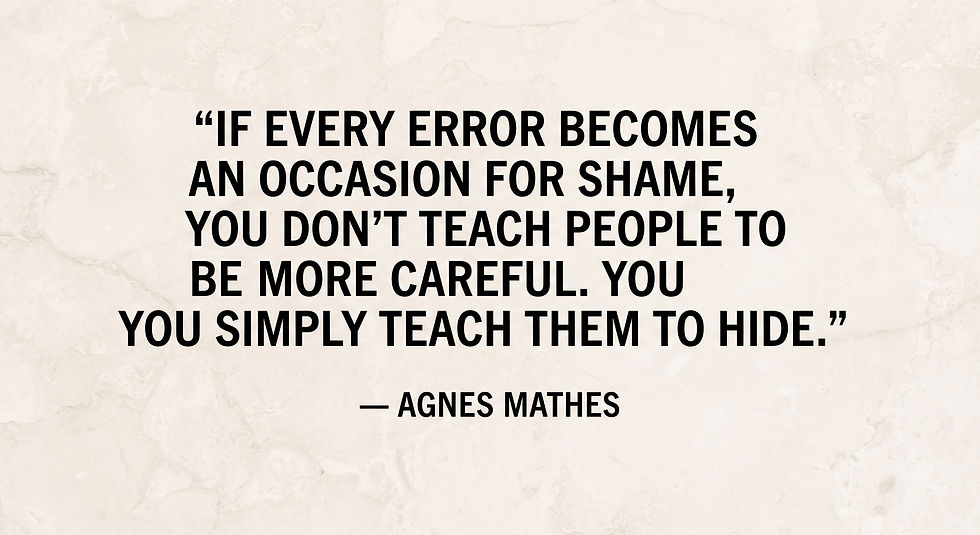
However, the better you learn to live with the risk of uncertainty, the more you will allow your people to grow. The energy they feel when they know you trust them, and that mistakes are simply part of the process, will help them thrive. As a leader, you will benefit from their unique wisdom and experiences, and together, you will reach levels you could never reach on your own.
Summing it up, practice these 6 steps:
Change your mindset: Recognize that the shift starts with you.
Accept the loss of control: Breathe, and let go.
Respect the roles: Ensure everyone owns their specific contribution.
Choose to trust: Let them do their job, so you can do yours.
Embrace differences: Accept diverse working styles and outcomes.
Intervene rarely: Step in only when guidance is truly needed (the 20%).


Comments